Juno Data Show Jupiter Tames the Solar Wind Differently Than Earth
A University of Iowa-led study in Nature Communications finds Jupiter’s bow shock uses waves at several frequencies and a precursor stage that Earth mostly lacks.
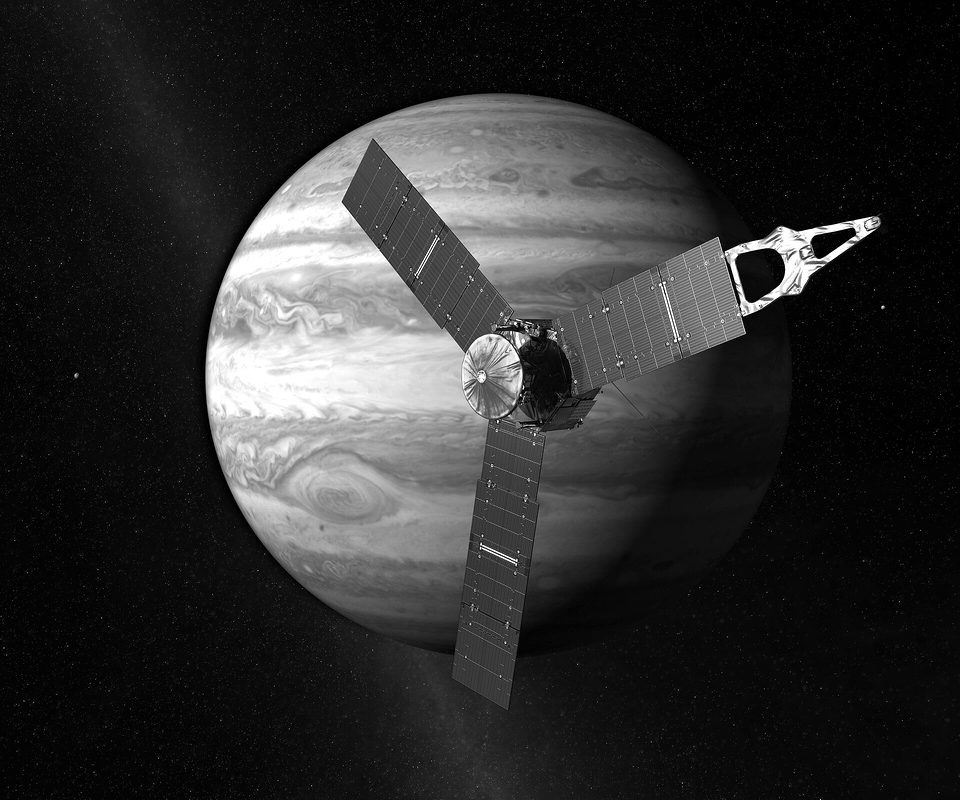

Jupiter slows and heats the stream of charged particles from the Sun in a more elaborate way than Earth does, according to a study of measurements from NASA’s Juno spacecraft. The paper, published online July 31, 2026 in Nature Communications, drew new press coverage this week.
Both planets have magnetic fields that deflect the solar wind. Where the wind meets a planet’s magnetic bubble it hits a boundary called the bow shock, in which the fast, thin plasma is abruptly slowed and heated. The study, whose title begins “Plasma wave observations from Juno spacecraft,” was led by researchers at the University of Iowa, with Jayasri Joseph as lead author and co-authors including W. S. Kurth and S. J. Bolton. NASA funded the work, according to ScienceDaily and EurekAlert.
The team used data Juno collected in December 2024. Juno has orbited Jupiter since July 2016, and the plasma-wave measurements came from an instrument called Juno Waves, which was built at Iowa. The authors report that Jupiter’s bow shock works through plasma waves at multiple frequencies, known as harmonics, to dissipate the solar wind’s energy. Earth’s bow shock, by contrast, relies mainly on waves around a single frequency.
The study also reports “shocklets” at Jupiter, which are small disturbances that begin to slow the solar wind before it reaches the main shock. Earth generally lacks this extra step. Joseph said in the university’s account carried by ScienceDaily that Jupiter has “found its own way” of dealing with the solar wind. Kurth said Earth has no need for these extra steps.
The authors suggest the findings have uses beyond Jupiter. Joseph said Jupiter’s bow shock gives scientists a close-by natural lab for understanding the more powerful shocks around objects such as supernova remnants, according to ScienceDaily.
This is a single study built on Juno data from December 2024, and neither account quotes an independent scientist, so how widely other researchers will accept the interpretation is not yet clear. Kurth attributes Earth’s simpler shock to the solar wind’s impact being less powerful there, which suggests the difference reflects conditions at each planet as much as a different kind of physics.
EurekAlert’s release says earlier spacecraft could detect Jupiter’s bow shock but not measure the complexity of its plasma waves, and calls these the most detailed observations of it to date. The authors report no conflicts of interest.
Sources
- ScienceDaily, Oct. 29, 2026: study findings, funder, Juno Waves instrument, Joseph and Kurth quotes <https://www.sciencedaily.com/releases/2026/10/261028232715.htm>
- EurekAlert, Sept. 21, 2026: University of Iowa release on the Nature Communications paper (DOI 10.1038/s41467-026-76223-x) <https://www.eurekalert.org/news-releases/1144729>
This article was drafted with AI writing tools from the sources listed, checked by a review pass, supervised by the paper’s editors and published by Daniel Varrone. Corrections: editor@monochromechronicles.com
More from Science
Recommended Reading
About this story: Compiled by the The Monochrome Chronicles desk from the sources listed above. Our standards · Report an error · Follow on YouTube