Science · Physics
Vienna Physicists Build the First Nuclear Clock That Keeps Itself on Time
The thorium-based prototype ran for more than a day without leaning on a conventional atomic clock, a step toward timekeepers that could one day outperform the best ones in use today.
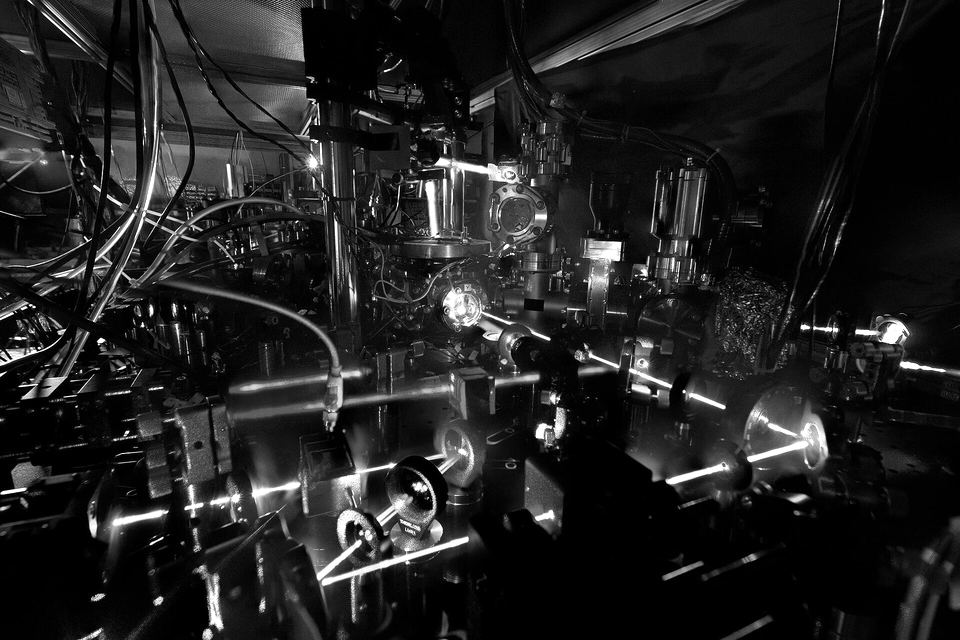

Physicists in Austria and Germany say they have built the first nuclear clock that stabilizes itself, a step toward keeping time with the core of an atom rather than its electrons. The team, led by Thorsten Schumm of the Vienna University of Technology, known as TU Wien, working with Ekkehard Peik of PTB in Braunschweig, Germany, described the device in the journal Nature. TU Wien announced the result on Oct. 8, and ScienceDaily carried the university’s account on Friday.
Today’s most precise clocks are optical atomic clocks, which count the vibrations of light absorbed by electrons in atoms. A nuclear clock instead uses a transition inside the atomic nucleus itself. Because nuclei are more than 10,000 times smaller than atoms, they are far less sensitive to stray electric and magnetic fields, which is why researchers think nuclear clocks could eventually surpass atomic ones.
The new device shines a laser on a specially grown crystal containing thorium-229, an isotope whose nucleus the same teams first showed could be excited by laser light. The nuclei absorb the light only at one exact frequency. If the laser drifts even slightly, the absorption drops, and a feedback loop automatically pulls the laser back on target. That self-correction is routine in atomic clocks but had not been achieved with a nuclear one.
“What you really want is a self-stabilizing nuclear clock,” Schumm said in the university’s announcement. Earlier versions depended on a conventional optical atomic clock to keep them on track. The new system ran steadily for more than 24 hours without intervention and did not need that outside reference.
The team reports a relative precision of about one part in a million billion, which the university translates into an error of roughly one second over 30 million years. That figure describes how precisely the clock’s frequency was measured, not a test that ran for anything like that long.
The work builds on two earlier steps by the same groups. In April 2024 they showed for the first time that thorium nuclei could be excited with laser light, and in the autumn of 2024 they linked the setup to a conventional optical clock so the nuclei acted as the timekeeper. TU Wien noted that a research group in China reported a nuclear clock in the same issue of Nature.
The researchers are careful about what they have not done. Their prototype is not yet as precise as the world’s best optical atomic clocks, which remain the benchmark, and claims that nuclear clocks will make atomic clocks obsolete run well ahead of the evidence. Reaching that level, they say, will take more powerful lasers and higher-quality thorium crystals. If it can be done, better timekeeping could also sharpen measurements of other physical quantities.
Sources
- TU Wien, Oct. 8, 2026: first self-stabilizing nuclear clock, Schumm and PTB’s Peik, Nature paper ‘A thorium-229 optical nuclear clock with feedback loop,’ feedback mechanism, more than 24 hours of stable operation, precision of about 10^-15, April and autumn 2024 milestones, Chinese group in the same issue, need for stronger lasers and better crystals, Schumm quote
- ScienceDaily, Oct. 10, 2026: TU Wien account of the clock, nuclei more than 10,000 times smaller than atoms, precision as a measured figure rather than a long test, prototype not yet as precise as the best optical atomic clocks, possible uses in measuring other physical quantities
This article was drafted with automated tools from the sources listed, checked by a review pass, and published by Daniel Varrone. Corrections: editor@monochromechronicles.com